
ERP stands for “Enterprise Resource Planning.”
One of the most important aspects of managing a business effectively is being able to allocate the business's resources in line with its goals and policies. This is where management systems developed for effective resource management come into play. With the advent of powerful computer systems and software, it became easier to achieve goals that were previously difficult to attain. This made it possible for all organizational functions to be controlled by a central structure. Thus, “Enterprise Resource Planning (ERP)” entered our lives.
Content

“Enterprise Resource Planning” is the integrated management of fundamental corporate functions such as purchasing and supply chain management, accounting, and the use of materials and resources necessary for the production of goods and services. This concept, now commonly referred to as ERP in our language, has a history spanning over 100 years. However, the use of ERP in businesses only dates back to the 1960s.
ERP systems bring together multiple business processes and enable data flow between these processes. As the definition suggests, the primary goal of ERP systems is to provide integration that makes resource planning efficient across different business processes. ERP software is like the central nervous system of people. Just as the central nervous system enables communication with the furthest points of the body, ERP systems aim to run business processes that touch the capillaries of the business in a coordinated manner with the management center and other units. As we said, the key concept here is integration.
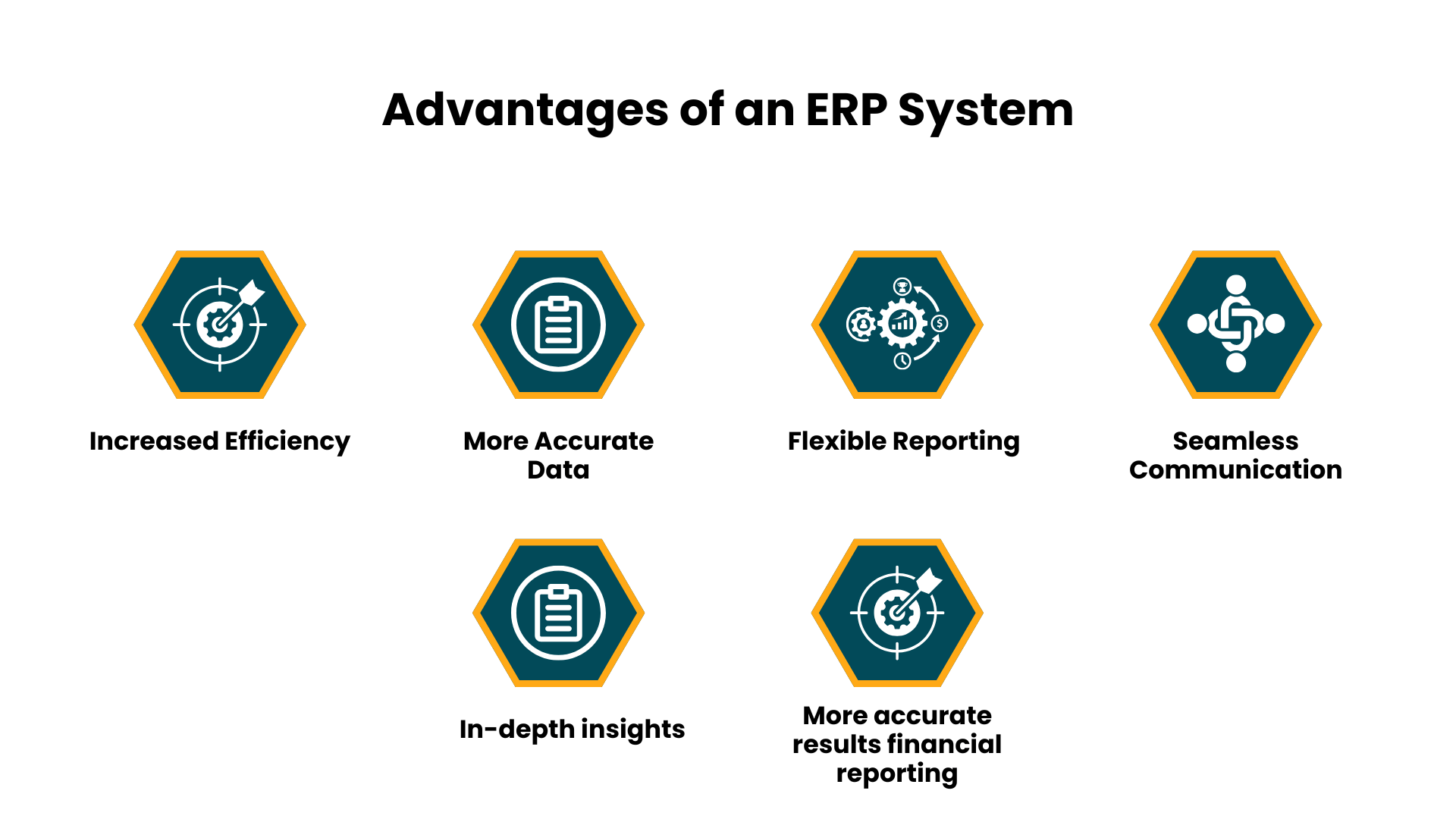
We mentioned that ERP systems emerged from the need for the proper use of resources. Since the proper use of resources is one of the fundamental needs of businesses, it must be said that ERP systems primarily fulfill the most important of these essential needs. However, if we elaborate a little more on the advantages of ERP systems, it must be said that these systems provide the following benefits to a business.
ERP systems both increase the business's production output (for services, this can also be referred to as better service output or added value) and reduce costs.
ERP software solutions enable the electronic management of the systems mentioned above. These software solutions are designed and coded to manage all processes that touch the capillaries of the business, from the supply chain to purchasing, from logistics to accounting, and from human resources to production. The primary goal of this software is to ensure that the processes in question are interconnected and communicate with each other through strong integration.
ERP software typically consists of modules. These modules cluster around key functions such as accounting and finance, purchasing and supply chain management, production, warehouse management and logistics, sales, and human resources. Some ERP programs include a significant portion of these modules, while others focus on only a subset.
The need for a business to operate in different locations or to access data from different places makes the hosting location of ERP software important. The need for location independence, along with the development of cloud technology, has also made it possible to host software in different locations and access it from anywhere. Roughly speaking, ERP software can be
While the choice between these models is up to the business, cloud hosting has become widespread today.
Cloud hosting technology, which is currently in high demand due to its accessibility from anywhere and its advantages in terms of updates, maintenance, and security, has also become the standard for ERP systems. This technology makes it possible to have an ERP software that is more accessible, secure, and easier to manage. Therefore, you can also choose to acquire the ERP systems you will implement for your company as Software as a Service (SaaS).
It would not be entirely accurate to say that an ERP system is good or bad for every business. This is because ERP programs may be quite adequate in some areas but may need improvement in others. In this regard, it is worth remembering that it is best for each business to use the ERP system that best suits its own structure.
ERP system changes can be quite demanding and sometimes costly. Therefore, consider the following when selecting the most suitable ERP system for your organization:
What is the scale of your business?
Business scale is one of the most important factors to consider when selecting ERP systems. This is because ERP software that is too narrow in scope or technologically inadequate to meet your needs can cause your operations to become bottlenecked. For example, if you are a retailer that issues tens of thousands of invoices per day, you need to select software that can easily manage this volume.
References
When selecting an ERP system, be sure to research where and how the candidate systems have been used before. Include decision-makers in your research, and if possible, include users as well.
Integration Capability
Check whether the ERP system can connect to your existing systems.
Suitability:
Evaluate how well the ERP system fits or can be adapted to all your processes, considering other candidates as well. Keep in mind at this stage that it may not be possible for every system to fit you 100%; focus on the closest options and ask whether they can be developed.
Maintenance and Support:
ERP systems will also live with your business and need support. Look for established developers and experienced teams.
ERP pricing varies depending on factors such as your business needs, the scope of the solution offered, integration requirements, and the need for additional development.
We mentioned above that the foundation of ERP is that ERP systems integrate with all systems like neural networks. In this context, it is important to add that ensuring that every system that touches the business's resources can work with the ERP system is essential for complete and effective resource planning.
Therefore, you should aim to ensure that the ERP system integrates with all your systems as expected.
Is ERP necessary for businesses of all sizes?
Since it's about resource planning, the short answer is yes! Every business needs an ERP system for efficiency.
I use an on-premises ERP system. Can I switch to a cloud-based system?
Of course, but check if your current system is compatible. If it's not compatible, consider switching to a cloud-based ERP system that suits your needs.
Can we transition to ERP incrementally without changing all our software?
Yes, you can. We recommend consulting an expert to determine what you need and which systems you want to integrate with.
We have software developed by our own team. Can we integrate the ERP system with these?
Absolutely. Today's technologies are highly capable of connecting any system to another.
Click here to learn more about Hamurlabs products!